Environmina Pest Control LLC

Flying Ants vs Termites NJ: A Scientific Homeowner’s Guide

In New Jersey, the sight of winged insects swarming inside a home often triggers immediate concern. While frequently dismissed as “just flying ants,” these sightings are a critical biological indicator of colony maturity and potential structural threats.

As a woman-owned business led by a professional chemist and toxicologist with over a decade of experience, Environmina Pest Control applies a science-led Integrated Pest Management (IPM) approach to identification and treatment across the Garden State.

Why Are They Flying? Understanding the “Swarm”

These winged insects are known as alates, or reproductives. Their sole purpose is to leave an established, overcrowded colony to mate and start new satellite colonies.

In New Jersey—from the urban corridors of Jersey City and Newark to the suburban landscapes of Edison and Bridgewater—this “swarm” typically occurs on warm, humid days following a spring rain. If you see these insects inside your home, it often indicates that the parent nest is already within your structure’s footprint.

The 3-Point ID Check: Ant (Formicidae) vs. Termite (Isoptera)

Before treating, you must confirm the specimen. Grab a magnifying glass and look for these three physical markers:

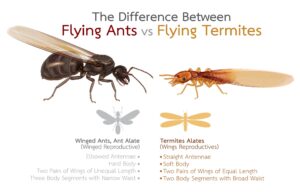
  1. The Waist: Ants have a distinct, pinched waist (pedicel). Termites have a broad, straight body with no visible waist.

  2. The Antennae: An ant’s antennae are “elbowed” or bent (genicolate). Termite antennae are straight and look like tiny rows of beads (moniliform).

  3. The Wings: Ants have two pairs of wings of different sizes (forewings are larger). Termite wings are all the same length and usually twice as long as their bodies.Flying ant versus termite NJ

Dominant Flying Ant Species in New Jersey

New Jersey’s diverse ecosystem means we see specific pests in different counties. Identifying the exact species is vital, as a “one-size-fits-all” spray can often cause budding (colony splitting), making the infestation worse.

1. Black Carpenter Ant (Camponotus pennsylvanicus)

The most significant structural ant threat in Livingston, Bernards, and Somerset.

  • The Danger: They do not eat wood but excavate it to build galleries, compromising structural integrity.

  • Scientific Marker: Large (up to 13mm) and dull black. Look for frass—sawdust-like piles containing insect parts.

2. Pavement Ant (Tetramorium caespitum)

The architects of the “sand volcanoes” in driveways in Jersey City and New Brunswick.

  • Identification: Dark brown to black, small (3mm). Under magnification, they show parallel ridges on the head and thorax.

  • Swarm Window: Typically late spring and early summer (June–July).

3. Citronella Ant (Lasius interjectus)

Common in Hunterdon and Warren Counties, these are frequently mistaken for termites due to their yellowish-brown alates.

  • Diagnostic Signal: When crushed, they emit a distinct lemon or citronella pheromone.

  • Habitat: They are subterranean, often nesting under concrete slabs and porches.

4. Winter Ant (Prenolepis imparis)

Often the first “flying ants” homeowners see in Union County or Middlesex Borough.

  • Behavior: Also known as “False Honey Ants,” they are active in near-freezing temperatures.

  • Swarm Window: Extremely early spring (March–April), often appearing while frost is still present.

5. Odorous House Ant (Tapinoma sessile)

The most common kitchen invader in Westfield and Cranford.

  • The Smell Test: If crushed, they release a chemical called methyl ketone, smelling like rotten coconuts.

  • Tactical Warning: These ants are highly prone to colony fracturing if treated with repellent chemicals.

6. Eastern Subterranean Termite (Reticulitermes flavipes)

While not an ant, this is the primary “look-alike” threat in Piscataway and Old Bridge.

  • The Danger: They consume cellulose (wood) and can cause thousands of dollars in damage silently.

The Environmina Advantage: Science Meets Pest Control

Traditional pest control often relies on broad-spectrum sprays. At Environmina, our background in chemistry and toxicology allows us to use Integrated Pest Management (IPM) to target the specific biology of each species.

  • Low-Toxicity Precision: We prioritize reduced-risk pesticides, green chemistry, botanical, and eco-friendly products that are tough on pests but safer for families and pets in Essex, Sommerset, Morris, Union, and Middlesex Counties.

  • Moisture-First Identification: Since most NJ wood-destroying organisms thrive on moisture, we identify structural vulnerabilities like clogged gutters or grading issues.

  • NJ-Exclusive Expertise: We are licensed exclusively in New Jersey, ensuring we follow the strict environmental and regulatory standards of the Garden State.

Protect Your New Jersey Investment

If you see a swarm, don’t wait for structural damage to become visible. Whether you are in Hillsborough, Plainfield, Piscataway, Somerset, Edison, or Hackettstown, scientific help is a phone call away.

Environmina Pest Control offers professional, high-level evaluations for homeowners throughout Hudson, Essex, Union, Middlesex, Somerset, Hunterdon, and Warren Counties.

Call us today at 848-482-0479 for a scientific inspection and experience a smarter, safer way to protect your home.