
Environmina Pest Control LLC

Carpenter Bee Exterminator NJ | Environmina Pest Control

Carpenter Bee Exterminator NJ | Environmina Pest Control
New Jersey's Carpenter Bee Specialists

Carpenter Bee Exterminator in NJ — Professional Gallery Treatment & 1-Year Warranty

Carpenter bees drilling into your deck, eaves, or siding? Environmina Pest Control uses a professional two-step liquid and dust treatment injected directly into nesting galleries — not just surface sprays. Led by a chemist and toxicologist, we eliminate infestations at the source and back every job with a full 1-year warranty.

1-Year Warranty — Longer Than Anyone Else in NJ Led by a Chemist & Toxicologist Liquid + Dust Gallery Treatment Residential & Commercial Open 24/7

Carpenter Bee Damage in NJ Is More Serious Than It Looks

Every spring, New Jersey homeowners across Middlesex, Somerset, Essex, Union, and Hudson Counties notice large, hovering bees and perfectly round holes in their decks and trim. What starts as a handful of entry holes can — over several seasons — become a network of tunnels several feet deep that structurally compromises the wood. The problem compounds each year because carpenter bees return to the same sites.

At Environmina Pest Control, our licensed carpenter bee exterminators in NJ begin every job with a thorough on-site inspection, identify all active galleries, and apply a two-step treatment — professional-grade liquid insecticide followed by insecticidal dust injected directly into each gallery. This combination reaches far deeper than any store-bought spray and eliminates the entire infestation, including bees that haven't emerged yet. We then seal the galleries to prevent re-entry, and every treatment comes backed by a full 1-year warranty.

$200–$600
Typical treatment cost in NJ
1 Year
Warranty — industry-leading
2-Step
Liquid + dust gallery treatment
24/7
Available — including weekends

Carpenter Bee vs. Bumblebee — NJ Identification Guide

Carpenter bees and bumblebees are similar in size and color, which leads to constant confusion. The key difference is one quick visual check — and it matters, because the treatment and risk level are completely different.

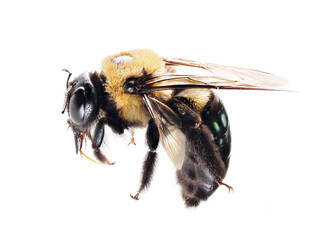
Carpenter Bee (Xylocopa virginica)
  • Abdomen: Smooth, shiny, solid black
  • Body: Large, robust — 3/4 to 1 inch long
  • Behavior: Solitary; bores into wood
  • Nesting: Drills perfectly round 1/2-inch holes into wood
  • Stinging: Males cannot sting. Females rarely sting unless severely provoked.
  • Flight: Hovering, darting, territorial near nest sites
  • Season: Active April through August in NJ
  • Concern level: Property damage — structural over time
Bumblebee (Bombus spp.)
  • Abdomen: Fuzzy, yellow and black striped
  • Body: Large, rounded — similar size to carpenter bee
  • Behavior: Social; lives in colonies
  • Nesting: In the ground, under decks, in compost piles
  • Stinging: Both males and females can sting and will defend nests aggressively
  • Flight: Foraging near flowers; less territorial
  • Season: Active April through October in NJ
  • Concern level: Sting risk near high-traffic areas

Not sure which bee you have? If you see a large bee flying in and out of a hole drilled into wood — that is a carpenter bee. If you see large bees going in and out of a hole in the ground or under your deck — those are most likely bumblebees. Call us at (848) 482-0479 for a fast identification and inspection.

Signs of a Carpenter Bee Infestation in Your NJ Home

Carpenter bee infestations rarely announce themselves loudly. Here are the six warning signs New Jersey homeowners most commonly find — if you're seeing any of these, it's time to call a professional before the damage compounds heading into next spring.

Perfectly round entry holes
Clean, circular holes about 1/2 inch in diameter bored into the surface of wood — most often on the underside of deck boards, fascia, railings, and eaves.
🪵
Sawdust (frass) below holes
Fine coarse sawdust piled directly below entry holes. This is the wood material the bees have bored out — a clear sign of active nesting.
🟤
Brown or yellow staining
Dark staining on the wood surface around or below the entry hole, caused by bee waste and pollen accumulation. This is cosmetic but confirms the nest is actively in use.
🐝
Hovering male bees
Large bees flying aggressively near the eaves, deck railings, or fascia boards. Male carpenter bees are territorial and will dive-bomb people near their nest — though they cannot sting.
🐦
Woodpecker activity on siding
Woodpeckers are attracted to the larvae developing inside carpenter bee galleries. Their pecking creates elongated, irregular holes far more damaging than the original entry point.
🔊
Buzzing or chewing sounds
A faint buzzing or rasping sound coming from inside wood structures — particularly in spring — indicates an active female excavating or expanding a gallery inside your wood.

⚠️ The Woodpecker Problem No One Else Is Telling You About

One of the most destructive — and least discussed — consequences of a carpenter bee infestation in New Jersey is secondary woodpecker damage. Woodpeckers, particularly the Downy and Hairy Woodpecker species common across Middlesex, Somerset, and Union Counties, are highly attracted to the sound and vibration of carpenter bee larvae developing inside gallery tunnels. They will systematically excavate large, jagged holes along your fascia boards and wooden siding trying to reach the larvae — damage that is significantly more expensive to repair than the original bee galleries. Eliminating the carpenter bee infestation early is the only reliable way to prevent woodpeckers from targeting your home. Call (848) 482-0479 before this two-stage damage cycle takes hold.

Carpenter Bee Activity Calendar for New Jersey

Understanding the seasonal cycle of carpenter bees in New Jersey helps you know exactly when to act — and when the treatment window is most effective. NJ's climate means an earlier spring emergence than most Northern states, which makes April the critical month for preventive treatment.

Spring
April – May
Emergence & nesting — the most critical treatment window
Overwintered adults emerge from their galleries in April as temperatures warm. Males immediately begin territorial hovering. Females start drilling new galleries or expanding existing ones to lay their eggs. This is the best time to treat: adult bees are active and present, making liquid and dust injection into galleries highly effective at stopping the infestation before eggs are laid. Homeowners in Edison, Piscataway, Bridgewater, and Flemington typically start seeing activity from mid-April onward.
Summer
June – August
Larval development & secondary treatment
Eggs hatch into larvae that develop inside the gallery tunnels. Sawdust and staining are most visible during this period. A follow-up dust application in early June ensures any late-emerging adults or newly hatched bees that weren't reached by the spring treatment are also eliminated. This is also peak season for the woodpecker damage that follows untreated infestations.
Fall
September – October
New adults emerge & galleries are sealed
New adults emerge in late August and September to feed on pollen before overwintering. Once activity has fully stopped — typically by late October — this is the ideal time to seal and plug all gallery openings with caulk or wood filler. Sealing galleries while bees are still active traps them inside, so fall sealing is a critical final step that locks in the treatment results.
Winter
November – March
Dormancy — plan your spring treatment now
Carpenter bees overwinter inside sealed galleries, re-emerging the following spring. If you're noticing sealed holes or prior staining from last season, the infestation is almost certainly still present and will resume activity as soon as temperatures rise above 55°F. Scheduling a preventive treatment appointment in March puts you ahead of the emergence window and avoids the spring rush.

Our Carpenter Bee Treatment Process — Liquid + Dust Gallery Injection

Most pest control companies apply a surface spray and call it done. At Environmina, our licensed NJ carpenter bee exterminators use a two-step gallery injection process that eliminates infestations at the source — not just at the opening. Here is exactly what happens when we arrive at your property.

Why liquid AND dust? Liquid insecticide penetrates deep into the gallery and kills adult bees on contact. Insecticidal dust adheres to the gallery walls, remaining active for weeks — killing larvae, newly emerging adults, and any bees that attempt to re-enter before the gallery is sealed. Together they close every gap that a single-method treatment leaves open.
1
Full property inspection
Our technician inspects all exterior wood surfaces — decks, eaves, fascia boards, pergolas, wooden siding, fencing, and outbuildings. We locate every active gallery opening and assess the depth of tunneling and the degree of structural involvement. We also identify any woodpecker damage and assess conditions that make re-infestation likely.
2
Liquid insecticide injection into galleries
Professional-grade liquid insecticide is injected directly into each identified gallery opening. The liquid penetrates deep into the tunnel structure, contacting adult bees and saturating gallery walls. This provides immediate knockdown of active bees present in the gallery at time of treatment.
3
Insecticidal dust application inside galleries
Insecticidal dust is then applied into each gallery opening. Unlike the liquid, the dust adheres to the gallery walls and remains active for weeks after application, continuing to kill any bees that enter or attempt to re-use the gallery — including larvae that hatch after the treatment date and newly emerged adults that weren't present during the initial visit.
4
Gallery sealing (a simple DIY step for homeowners)
Once all bee activity in treated galleries has fully ceased — typically 3 to 4 weeks post-treatment — the gallery openings should be sealed with caulk, wood putty, or wood filler to prevent future use. This is a straightforward step that most homeowners can do themselves with materials available at any hardware store. Timing is the only critical factor: galleries must never be sealed while bees may still be inside, as this traps them and causes further damage. We recommend waiting until late fall — October or November — once all activity has clearly stopped before sealing. We are happy to advise you on exactly what to look for before you seal.
5
Follow-up inspection & warranty confirmation
Every carpenter bee treatment by Environmina is backed by a full 1-year warranty. If carpenter bees return to treated areas within 12 months, we return and retreat at absolutely no additional cost. We also provide personalized prevention recommendations — wood painting, surface treatment, and structural repairs — to reduce future risk.

How Much Does Carpenter Bee Extermination Cost in NJ?

Carpenter bee treatment at Environmina Pest Control ranges from $200 to $600 for most New Jersey homes. The final cost depends on four factors: the number of active galleries, the depth of the tunnels, the accessibility of affected areas, and whether a follow-up visit is needed. Here's a practical breakdown.

ScenarioTypical RangeWhat affects the cost
Small infestation — a few galleries on a deck railing or single fascia board, easily accessible$200 – $300Low gallery count, ground-level or easily reached, limited tunneling depth
Moderate infestation — multiple galleries on a deck, pergola, or eaves, some elevated areas$300 – $450Multiple nesting sites, some ladder work required, second-story eaves or overhangs
Extensive infestation — widespread galleries across multiple structures, deep tunneling, significant prior damage$450 – $600High gallery count, structural involvement, extensive tunneling, follow-up visit included
Commercial properties — multi-structure, outbuildings, larger infestationsCustom quoteSquare footage, number of structures, degree of infestation

Every carpenter bee treatment by Environmina includes a free on-site inspection, the two-step liquid and dust gallery injection, and our ✓ 1-Year Warranty — if carpenter bees return within 12 months, we come back at no additional charge. Most competitors offer only 90 days. Call (848) 482-0479 to schedule your free inspection and receive an accurate, no-obligation quote.

Carpenter Bee Exterminator Serving Your NJ County

Environmina Pest Control serves residential and commercial customers across Central and Northern New Jersey. Our technicians are familiar with the wood structures, home ages, and carpenter bee activity patterns specific to each region — from the older craftsman homes in Essex County to the suburban deck-heavy communities of Middlesex and Somerset.

Middlesex County
Edison · Piscataway · Woodbridge · Old Bridge · New Brunswick · Metuchen · Sayreville · East Brunswick · Monroe · South Brunswick
Somerset County
Bridgewater · Hillsborough · Bernards · Bound Brook · Manville · Raritan · Franklin · Green Brook · Warren · Watchung
Union County
Westfield · Scotch Plains · Plainfield · Cranford · Linden · Elizabeth · Rahway · Kenilworth · Summit · Springfield
Essex County
Newark · West Orange · Livingston · Irvington · Montclair · Bloomfield · Nutley · Belleville · Maplewood · South Orange
Hudson County
Jersey City · Bayonne · Union City · Hoboken · Kearny · Secaucus · North Bergen · Weehawken · Harrison
Hunterdon County
Flemington · Clinton · Readington · White House Station · Lebanon · Branchburg · Frenchtown · Lambertville
Warren County
Washington · Hackettstown · Phillipsburg · Lopatcong · Pohatcong · Oxford · Belvidere

Not sure if we serve your area? Call us at (848) 482-0479 — we serve all of Central and Northern New Jersey and can confirm service availability for your location immediately.

Frequently Asked Questions — Carpenter Bees in NJ

These are the questions we hear most often from New Jersey homeowners dealing with carpenter bees. If your question isn't answered here, call us at (848) 482-0479 and we'll answer it directly.

Do carpenter bees sting?
Male carpenter bees are completely stingless — they have no stinger at all. They may fly close to your head or hover aggressively if you approach the nest, which is alarming, but they are physically incapable of stinging. Female carpenter bees do have a stinger and can sting, but they are naturally non-aggressive and almost never do unless you handle them directly or press them against your skin. The main risk from carpenter bees is not personal injury but the structural damage they cause to your home over time.
How much does carpenter bee extermination cost in NJ?
At Environmina Pest Control, carpenter bee treatment in New Jersey typically ranges from $200 to $600 for residential properties. The cost depends on the number of active galleries, the depth of the tunneling, and the accessibility of the affected areas. Every treatment includes our two-step liquid and dust gallery injection process and a full 1-year warranty. Call (848) 482-0479 for a free, no-obligation inspection and an accurate quote based on your specific situation.
What is the difference between a carpenter bee and a bumblebee?
The single fastest way to tell them apart is to look at the abdomen. Carpenter bees have a smooth, shiny, solid black abdomen. Bumblebees have a fuzzy abdomen with yellow and black striping. Carpenter bees are solitary and drill into wood to nest; bumblebees are social and nest in the ground or under structures. If you see a large bee going in and out of a hole bored into wood — it is a carpenter bee. If you see a large bee going into a hole in the ground — it is likely a bumblebee.
Will carpenter bees come back after treatment?
Without proper treatment and gallery sealing, yes — carpenter bees return to the same sites every year. This is one of the most frustrating aspects of a carpenter bee infestation. Our two-step liquid and dust gallery injection eliminates active adults, larvae, and newly emerging bees. When galleries are sealed after treatment, the nesting site is permanently removed. All of our work is backed by a full 1-year warranty: if carpenter bees return to treated areas within 12 months, we come back and retreat at absolutely no additional cost.
When is the best time to treat carpenter bees in New Jersey?
The most effective treatment window in New Jersey is spring — specifically April and May — when carpenter bees first emerge from overwintering and begin drilling new galleries. Treating during this period reaches adult bees while they are actively present and stops the nesting cycle before eggs are laid. A follow-up dust application in June addresses any bees that weren't present during the initial visit. Gallery sealing is done in late fall once all activity has stopped, typically October or November.
Can carpenter bees cause structural damage?
Yes, over time. A single carpenter bee gallery drilled in one season is primarily a cosmetic issue. But carpenter bees return to the same sites year after year, boring new galleries alongside old ones. Over multiple seasons, this creates a network of tunnels that can extend several feet deep into deck boards, fascia, pergola beams, and wooden siding, significantly weakening the structural integrity of the wood. The secondary woodpecker damage that commonly follows an untreated carpenter bee infestation — where woodpeckers peck into siding to reach the larvae — can be even more destructive and costly to repair.
What wood do carpenter bees prefer in NJ homes?
Carpenter bees strongly prefer soft, unpainted, untreated, or weathered wood. In New Jersey homes, the most commonly affected surfaces are cedar and pine decks, fascia boards under the roofline, pergolas, wooden fencing, porch railings, barn wood, and exposed outdoor structural beams. Painted and pressure-treated wood is less attractive to them — but not immune. If untreated wood is not available, carpenter bees will drill into painted surfaces. This is why preventive painting and staining of all exterior wood is one of the most effective long-term deterrents.
Why are carpenter bees called carpenter bees?
Carpenter bees get their name from their nesting behavior. Unlike most bees that build hives from wax or nest in the ground, carpenter bees use their powerful mandibles to drill and chew precise, circular tunnels into solid wood — much like a carpenter working wood with a drill. Each tunnel, called a gallery, can extend several feet deep and contains multiple brood chambers where the female lays her eggs. The skill and precision with which they bore into wood is what gave them the carpenter name.

Ready to Eliminate Your Carpenter Bee Problem?

Get a free, no-obligation inspection from New Jersey's most scientifically rigorous carpenter bee exterminators. Led by a chemist and toxicologist. Backed by a 1-year warranty.

Open 24 hours a day, 7 days a week · Serving Middlesex, Somerset, Union, Essex, Hudson, Hunterdon & Warren Counties

carpenter bee exterminator NJ
NJ carpenter bee experts
carpenter-bee-life cycle
Carpenter Bee Exterminator near me