German Cockroach Exterminator NJ
Blattella germanica — Eliminated at the Source
One mated pair can become 30,000 roaches in a single year. Environmina's IPM-based protocols target the entire colony — not just the roaches you see.
Species Identification
How to Identify a German Cockroach in Your NJ Home
Of the four cockroach species commonly found in New Jersey, Blattella germanica is the one most frequently found inside kitchens, bathrooms, and food service facilities — and the most difficult to eliminate without professional intervention.
If you see one German cockroach during the day, population pressure inside hidden harborage sites is already high. German cockroaches are nocturnal. Daytime sightings indicate a colony large enough to force roaches out of their preferred hiding spots. Do not delay treatment.
Species Profile: German Cockroach
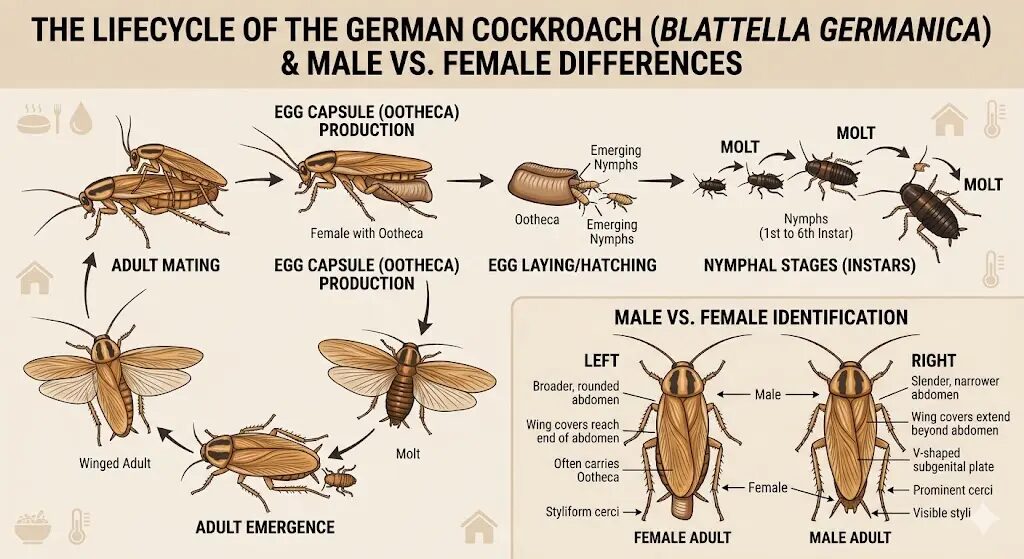
Blattella germanica (Linnaeus, 1767) · Family: Ectobiidae| Adult size | ½ inch (13–16 mm) — smaller than American and Oriental cockroaches |
| Color | Light tan to medium brown with two dark parallel stripes running from the head to the wing base — the most reliable field identification mark |
| Wings | Adults have wings but rarely fly; wing pads are visible on later-instar nymphs |
| Nymphs | Darker, nearly black with a tan stripe; often mistaken for a different species; same two-stripe pattern becomes visible in later instars |
| Egg case (ootheca) | Tan, 8–9 mm long; contains 30–40 eggs; female carries until 1–2 days before hatching (unlike other species that deposit the case early) |
| Preferred habitat | Warm (75–95°F), humid microenvironments: behind stove control panels, refrigerator compressor compartments, inside dishwasher frames, under sink plumbing, inside wall voids near heat sources |
| Behavior | Strongly thigmotactic (seeks tight, enclosed spaces); highly gregarious; deposits aggregation pheromones that attract other roaches to the same hiding sites |
| NJ activity | Year-round indoor pest; population peaks in late summer when heat and humidity accelerate nymphal development; frequently introduced via grocery bags, cardboard boxes, second-hand appliances, and shared apartment walls |
| Compared to American roach | Much smaller; exclusively indoor; never found in sewers or crawl spaces as a primary habitat; far more prolific reproductive rate |
The Colony Clock: Why Speed of Response Matters
Starting from a single mated female introduced into your home — here's what happens without treatment:
Day 0
2
1 mated pair enters home
→Week 6
~40
First generation nymphs hatch & mature
→Month 3
~400
Multiple egg cases hatch simultaneously
→Month 6
~5,000
Overlapping generations multiplying
→Month 12
30,000+
Full infestation; visible in daytime throughout home
Source: Comprehensive reproductive data published in entomology literature on Blattella germanica under optimal indoor conditions (75–85°F, food and water available).
Detection
Signs of a German Cockroach Infestation in Your NJ Property
German cockroaches leave multiple indicators of their presence. Knowing what to look for helps you catch an infestation early — before it reaches the hundreds or thousands.
Fecal deposits
Small, dark specks resembling ground pepper or coffee grounds; found in corners, along edges of shelving, inside cabinet hinges, and near drain openings. Heavy infestations produce dark smear marks along walls.
Musty odor
A distinct oily, musty smell produced by German cockroach pheromones and waste. Noticeable in high-infestation areas; sometimes described as "greasy" or similar to soy sauce.
Shed skins (exuviae)
Nymphs molt 6 times before becoming adults. Translucent or pale tan shed skins accumulate near harborage sites — often found inside electrical outlets, cabinet hinges, and behind appliances.
Egg cases (oothecae)
Tan, capsule-shaped cases approximately 8–9mm long. May be found attached to surfaces near harborage sites, carried by females until just before hatching. Each contains 30–40 eggs.
Nighttime activity
Turning on a kitchen light at night and seeing roaches scatter is a classic sign. German cockroaches are strongly photophobic and retreat rapidly when disturbed by light.
Daytime sightings
A severe infestation warning sign. When populations become overcrowded, subordinate individuals are pushed out of harborage sites during daylight hours. Immediate professional treatment is needed.
Public Health Impact
Why German Cockroaches Are a Serious Health Threat in NJ Homes
This is not simply a nuisance pest. The presence of Blattella germanica in your home or business creates documented, measurable health risks for your family or customers — particularly in densely populated NJ communities.
🫁 Asthma & allergic disease
German cockroach allergens — proteins found in their shed skins, saliva, and fecal matter — are among the most potent indoor asthma triggers identified by the National Institute of Environmental Health Sciences (NIEHS). In urban NJ environments, cockroach sensitization rates in asthmatic children commonly exceed 50%. Allergen levels persist long after roaches are eliminated without professional sanitation protocols.
🦠 Bacterial contamination
German cockroaches forage through sewage, garbage, and food simultaneously. Their bodies and legs carry Salmonella typhimurium, Escherichia coli, Staphylococcus aureus, and Streptococcus, which are deposited on food contact surfaces, utensils, and food packaging as they forage. A single cockroach contact with a food surface is sufficient to cause contamination.
🐛 Parasitic disease vectors
Research has documented German cockroaches carrying eggs of parasitic helminths (tapeworms, roundworms) on their exoskeletons. While not the primary vector for these organisms, cockroach-contaminated food and surfaces represent a meaningful transmission pathway in households with pets or young children who have hand-to-mouth contact.
🏢 Commercial & regulatory liability
For NJ food service operators, a confirmed German cockroach infestation can result in immediate NJ Department of Health inspection failures, mandatory closure, and health code violations. A single customer complaint documenting a cockroach sighting can result in reputational damage that far exceeds the cost of proactive professional pest control.
Our Treatment Protocol
Why German Cockroach Elimination Requires Science, Not Just Spray
Environmina's owner holds a B.S. in Toxicology and applies that scientific foundation to every treatment. German cockroaches have developed documented resistance to many over-the-counter insecticides — which is why our protocol is built on mechanism of action diversity and colony-level targeting.
Why store-bought sprays make German cockroach infestations worse: Repellent consumer sprays drive roaches deeper into wall voids, fracture the colony into multiple satellite groups, and accelerate resistance development. Within weeks, survivors with resistance genes become the dominant breeding population. Professional IPM protocols are specifically designed to avoid this outcome.
Thorough IPM Inspection
We locate every active harborage zone using a combination of visual inspection, flushing agents, and sticky trap placement. We document entry points, moisture sources, and sanitation conditions that are sustaining the infestation — issues that treatment alone cannot solve.
Gel Bait Application (Primary)
Professional-grade gel bait is applied in precise micro-placements directly inside crack and crevice harborage sites — not broadcast onto surfaces. Foraging roaches consume the bait and transfer it to nestmates through trophallaxis and fecal feeding, achieving secondary kill throughout the colony without exposing your family to chemical residues.
Insect Growth Regulator (IGR)
We apply a professional-grade IGR (Insect Growth Regulator) to harborage zones. IGRs mimic juvenile insect hormones and prevent nymphs from reaching reproductive maturity and prevent egg case development. This breaks the reproductive cycle at the biological level — ensuring that surviving roaches and hatching nymphs cannot replenish the population.
Targeted Residual Application
Where appropriate, a professional non-repellent liquid residual is applied to void spaces and travel routes — not living surfaces. Non-repellent chemistry allows roaches to walk through treated areas without detecting the product, maximizing horizontal transfer to nestmates.
Exclusion & Sanitation Consulting
We identify and seal plumbing gaps, appliance voids, and wall penetrations that serve as harborage and travel corridors. We provide specific, actionable sanitation recommendations targeting the moisture and food sources sustaining your infestation — not generic advice.
Follow-Up & Monitoring
We return within 2–3 weeks to assess treatment efficacy, replace depleted bait placements, and treat any nymphs that have hatched from egg cases that were sheltered during initial treatment. All services are backed by our 90-day service warranty — if German cockroaches return, so do we.
Why Environmina
The Environmina Difference — Science, Accountability & Local Expertise
Not all pest control companies are the same. Here is what sets Environmina apart when it comes to German cockroach control in New Jersey.
Toxicology-backed protocols
Our owner holds a B.S. in Toxicology. Every product selection, application rate, and placement decision is grounded in chemistry — not just a spray schedule.
NJ DEP Licensed
Fully licensed by the New Jersey Department of Environmental Protection. All technicians are trained, insured, and operating within NJ state pesticide regulations.
IPM approach
Integrated Pest Management means we use the least-toxic effective option first — gel bait and IGR over broadcast spraying. Safer for your family; harder on roaches.
Family-owned & local
Based in Middlesex, NJ. We serve the same communities where we live. Our reputation is built one neighbor at a time — which is why we don't cut corners.
90-day service warranty
If German cockroaches return within 90 days of treatment, we return at no additional charge. We stand behind our work completely.
24/7 availability
Pest problems don't follow business hours. We are available around the clock, including nights, weekends, and same-day emergency appointments.
Local Service Coverage
German Cockroach Control Across Middlesex County & All 7 Service Counties
German cockroaches are particularly prevalent in New Jersey's densely populated urban areas and multi-unit housing — exactly the communities Environmina serves. We provide German cockroach extermination across all of the following areas, with rapid response times throughout Central and Northern NJ.
Also serving all of Middlesex, Somerset, Essex, Union, Hudson, Hunterdon, and Warren Counties. View full service area →
Frequently Asked Questions
German Cockroach Questions — Answered by a Toxicology Expert
These are the questions NJ homeowners and business owners ask us most often about German cockroach control.
How do I know if I have German cockroaches vs. another species?
German cockroaches (Blattella germanica) are small — about ½ inch — tan to light brown, and have two distinct dark parallel stripes running from behind the head to the wing base. They are almost exclusively found indoors — kitchens, bathrooms, and behind appliances — unlike American or Oriental roaches, which often migrate from outdoors. If you see small tan roaches near your stove, refrigerator motor, or under the sink, you almost certainly have German cockroaches. Our free inspection will confirm the species and inform the right treatment protocol.
Why won't store-bought sprays get rid of German cockroaches?
Repellent sprays drive German cockroaches deeper into wall voids and cracks, scatter the colony into satellite groups, and accelerate resistance development. German cockroaches have documented resistance to many common over-the-counter consumer sprays. Professional IPM protocols use non-repellent gel baits placed in harborage zones combined with Insect Growth Regulators (IGRs) that sterilize surviving adults — breaking the reproductive cycle that store-bought products cannot touch.
How fast do German cockroaches reproduce?
Blattella germanica is the most prolific of all cockroach species. A single female produces an ootheca (egg case) containing 30–40 eggs every 3–4 weeks and carries it until nearly the time of hatching — protecting the entire brood from pesticide exposure. Nymphs reach reproductive maturity in as little as 6 weeks under warm indoor conditions. Starting from a single mated pair, populations can exceed 30,000 individuals in one year — which is why early, professional intervention is critical.
How many treatments are needed to eliminate German cockroaches from my NJ home?
Most moderate German cockroach infestations require an initial treatment followed by at least one follow-up visit 2–3 weeks later to address nymphs hatching from any egg cases that were protected during the first treatment. Severe infestations in multi-unit housing or commercial kitchens may require 3–4 visits over 6–8 weeks. All Environmina treatments are backed by a 90-day service warranty — if roaches return within the warranty period, we return at no additional charge.
Are your German cockroach treatments safe for children and pets?
Yes. Environmina's owner holds a B.S. in Toxicology and designs every treatment protocol to minimize exposure risk. We use targeted gel bait applications placed inside cracks and crevices — not broadcast sprays — so active ingredients are inaccessible to children and pets but fully accessible to foraging cockroaches. All products used are EPA-registered and applied according to NJ DEP licensing standards. We will give you specific preparation instructions and re-entry times before any treatment.
Do German cockroaches cause health problems?
Yes — documented health risks include: asthma and allergic rhinitis (cockroach allergen proteins in shed skins and feces are a leading indoor asthma trigger per the NIEHS, especially affecting children in urban environments); bacterial contamination of food and surfaces including Salmonella, E. coli, and Staphylococcus; and transport of parasitic organisms. The longer an infestation persists, the higher the allergen load in your home — professional treatment and post-treatment sanitation are both important.
Can I prepare my own home before the exterminator arrives?
Yes, and it helps. Before your appointment: clear items from under sinks and the backs of cabinets to allow technician access; remove pet food and water bowls from floors; clean grease buildup from stove tops and behind appliances if possible; and avoid spraying any commercial roach spray for at least 48 hours before treatment, as repellent chemicals in these products can interfere with gel bait uptake. We will provide a complete preparation checklist when you schedule your appointment.
I live in an apartment — can German cockroaches come from my neighbor's unit?
Yes. This is one of the most common German cockroach introduction pathways in New Jersey's dense housing stock. German cockroaches travel freely through shared wall voids, plumbing chases, electrical conduits, and gaps around pipes between units. In multi-unit buildings, effective control requires treating all actively infested units and sealing inter-unit penetration points. We work with property managers and landlords to coordinate building-wide treatment programs when necessary.
Related Services
Explore More Pest Control Services from Environmina
German Cockroaches Won't Disappear on Their Own.
Call Environmina Today.
Every day without treatment is another generation of roaches reproducing in your walls. Our NJ DEP-licensed team is ready 24/7 — including same-day emergency appointments.